Crab
Crab
LIMITED EDITION OF 30 WORLDWIDE
Across all sizes and formats
Signed and numbered
Certificate of Authenticity included
Museum-quality production
Worldwide shipping available
Framing and custom sizes are available upon request.
All prices are listed in euros and include 6% VAT. Shipping costs are not included.
The story behind the photo
“CRAB”
A Story from Ascension Island
Johngarthia lagostoma | Ascension Island, South Atlantic Ocean
In the middle of the South Atlantic Ocean, more than a thousand kilometres from the nearest continental coastline, lies Ascension Island — a remote volcanic outpost shaped by fire, isolation and an extraordinary history. First encountered by Portuguese navigators in the early 16th century, the island remained uninhabited for centuries. Its barren volcanic landscapes, resembling the surface of the Moon, eventually became home to military installations, scientific facilities and an unusual mixture of introduced plants and animals. Today, the contrast is striking: rust-red volcanic plains surround Green Mountain, whose summit is covered in lush vegetation.
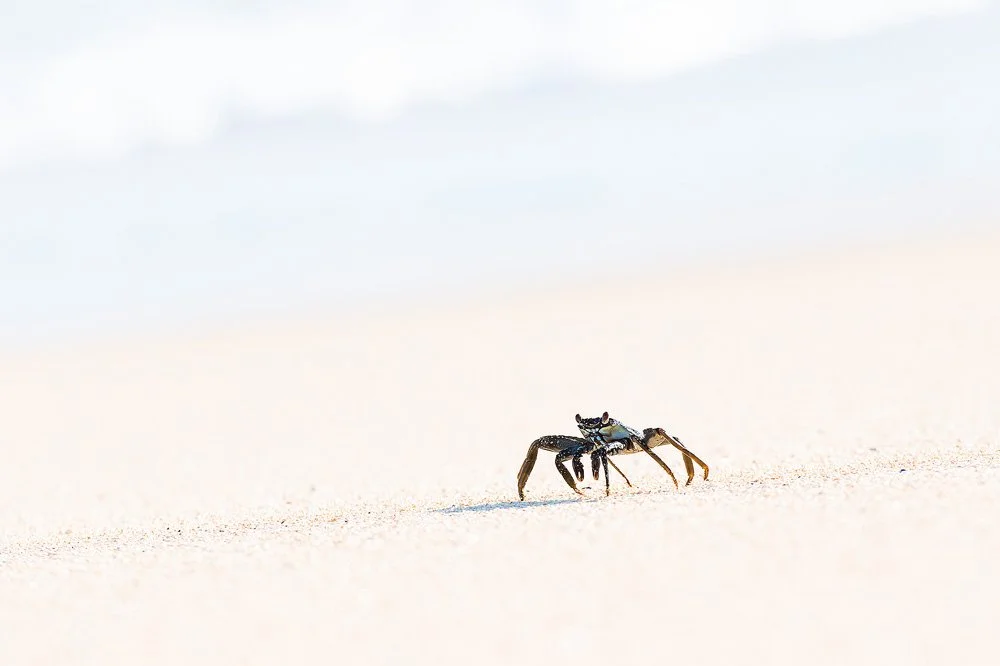
Access to Ascension Island is restricted and requires special permission from the British authorities. It is not a place one simply visits. Among the island's remarkable inhabitants is Johngarthia lagostoma, a land crab whose vivid colours stand out against the dark volcanic terrain. These crabs spend much of their lives on land, yet remain connected to the ocean, returning to the coast to reproduce. Photographing one was a challenge of patience rather than distance. I spent two and a half hours working on this single image, waiting for the right position, light and moment to capture the animal in its natural environment. The resulting photograph, Crab, is more than a portrait of an unusual species. It is a glimpse into the extraordinary biodiversity of one of the Atlantic's most isolated islands, where life has found ways to survive in an environment that, at first glance, seems almost inhospitable. A particularly remarkable aspect of this species is its annual migration from the island's higher elevations to the coast, where females release their larvae into the Atlantic. The crab's survival is therefore inseparable from both the volcanic island it inhabits and the surrounding ocean.
For me, Crab also represents something fundamental about wildlife photography: the most memorable images are not necessarily the result of extraordinary equipment or complicated techniques, but of time, observation and patience. Two and a half hours for a fraction of a second, and a photograph that preserves an encounter with one of the Atlantic's most remarkable island inhabitants.
“CRAB”
Een verhaal van Ascension Eiland
Johngarthia lagostoma | Ascension, Zuid-Atlantische Oceaan
Midden in de Zuid-Atlantische Oceaan, op meer dan duizend kilometer van de dichtstbijzijnde continentale kustlijn, ligt Ascension — een afgelegen vulkanisch eiland gevormd door vuur, afzondering en een buitengewone geschiedenis. Het eiland werd in het begin van de 16e eeuw voor het eerst ontdekt door Portugese zeevaarders en bleef eeuwenlang onbewoond. De kale vulkanische landschappen, die doen denken aan het maanoppervlak, werden uiteindelijk de thuisbasis van militaire installaties, wetenschappelijke faciliteiten en een ongewone mengeling van geïntroduceerde planten en dieren. Tegenwoordig is het contrast opvallend: roestrode vulkanische vlaktes omringen Green Mountain, waarvan de top bedekt is met weelderige vegetatie.
Toegang tot Ascension Island is beperkt en vereist speciale toestemming van de Britse autoriteiten. Het is geen plek die je zomaar bezoekt. Een van de opmerkelijke bewoners van het eiland is de Johngarthia lagostoma, een landkrab waarvan de levendige kleuren afsteken tegen het donkere vulkanische terrein. Deze krabben brengen een groot deel van hun leven op het land door, maar blijven toch verbonden met de oceaan: ze keren terug naar de kust om zich voort te planten. Het fotograferen van een exemplaar was eerder een kwestie van geduld dan van afstand. Ik heb tweeënhalf uur aan deze ene foto gewerkt, wachtend op de juiste positie, het juiste licht en het juiste moment om het dier in zijn natuurlijke omgeving vast te leggen. De resulterende foto, ‘Crab’, is meer dan een portret van een ongewone diersoort. Het is een kijkje in de buitengewone biodiversiteit van een van de meest afgelegen eilanden in de Atlantische Oceaan, waar het leven manieren heeft gevonden om te overleven in een omgeving die op het eerste gezicht bijna onherbergzaam lijkt. Een bijzonder opmerkelijk aspect van deze soort is de jaarlijkse migratie van de hoger gelegen delen van het eiland naar de kust, waar de vrouwtjes hun larven in de Atlantische Oceaan loslaten. Het voortbestaan van de krab is daarom onlosmakelijk verbonden met zowel het vulkanische eiland waarop hij leeft als de omringende oceaan.
Voor mij vertegenwoordigt ‘Crab’ ook iets fundamenteels over natuurfotografie: de meest gedenkwaardige beelden zijn niet noodzakelijkerwijs het resultaat van buitengewone apparatuur of ingewikkelde technieken, maar van tijd, observatie en geduld. Tweeënhalf uur voor een fractie van een seconde, en een foto die een ontmoeting met een van de meest opmerkelijke eilandbewoners van de Atlantische Oceaan vastlegt.